County of San Diego
Similar to last year, but with new activities, booth will feature Live Well San Diego is various ways using hands-on activities for children and families of the topics of health, safety and well-being.

Similar to last year, but with new activities, booth will feature Live Well San Diego is various ways using hands-on activities for children and families of the topics of health, safety and well-being.
The UC San Diego Eating Disorders Center for Treatment and Research and the Center for Healthy Eating and Activity Research (CHEAR) are teaming up to recruit for various research studies on healthy eating and skill-based learning. Our research integrates brain imaging modalities to understand brain structure and function in eating disorders. CHEAR develops and provides treatments for promoting healthy eating and weight management to children, adolescents, adults through science and innovation.
Biology in 3D: The Protein Data Bank is the single worldwide resource for the 3D structures of proteins and DNA. You will learn about two basic building blocks of life: DNA and Proteins and then build a model of each. You will also see computer animations of 3D protein and DNA structures and learn how medicines work.
UCSD Skaggs School of Pharmacy booth will provide an exposure to the health services that pharmacists provide to our society. Through a series of fun and interactive activities, visitors will learn about different diseases such as hypertension, diabetes and asthma. Furthermore, the booth will provide information about immunization, medication safety and pharmaceutical compounding. Examples of activities include learning how to use inhalers and ingredients necessary for pharmaceutical compounding
The Boy Scouts of America's STEM committee would like to have a booth featuring the NOVA Awards program which incorporates learning with cool activities and exposure to science, technology, engineering and mathematics (STEM). The hope is that these awards stimulate interest in STEM-related fields and shows how science, technology, engineering and mathematics apply to everyday living and the world around them.
http://www.sdicbsa.org/Advancement/STEMNovaProgram.php
Join EcoVivarium as they bring hidden reptiles, amphibians and bugs - out from under the rocks and out of the shadows into the light of day. Together we will travel back in time to take a look at their influence on science, art, cultures and history from Aboriginal tribes, ancient Egypt and all the way up through modern medicine and the critical role they play saving lives each and every day. It's a fascinating world they live in, come along with EcoVivarium as we Step In To Their World...(R)
This exhibit is organized by the RCSB Protein Data Bank (PDB) at UCSD. The PDB is the single worldwide resource for the 3D structures of proteins and DNA.
In this exhibit students will learn about the basic building blocks of life: DNA and Proteins. The first part consists of building a small fragment of double stranded DNA using marshmallows and tooth picks. In the second part, students will build a small portion of protein backbone by visualizing it on a computer display and then folding it from a piece of wire. They will learn about alpha helices and beta sheets.
This year we would like to have 3 different projects to present to the students.
1. Organ matching board: This is a fun activity for younger kids (elementary) to try to match the cartoon organs to the appropriate function and associated disease.
UCSD Skaggs School of Pharmacy booth will provide an exposure to the health services that pharmacists provide to our society. Through a series of fun and interactive activities, visitors will get the chance to learn about different disease such as hypertension, diabetes and asthma. Furthermore, the booth will provide information about immunization, medication safety and pharmaceutical.
Visitors to the booth can participate in a walkthrough illustrating the basics of genetics and how DNA can affect our physical beings. Following the walkthrough, visitors can enjoy three hands on activity stations. The first is a Build your own DNA station, where visitors can build a base or practice pairing them. The second is a genetic engineering station, where student can manipulate circuits or help insert a plasmid (glow bracelet) into a bacteria (balloon). At the final station, a robot can be build based on the selection of dominate or recessive genes from two parent robots.
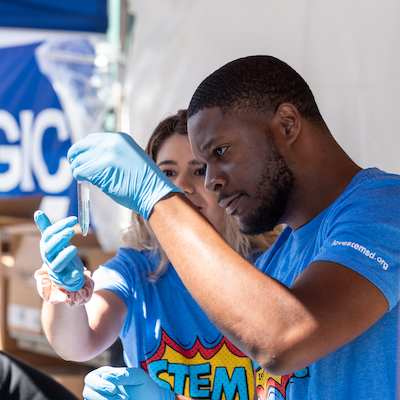
It takes true community spirit and engagement to build a successful Festival and create meaningful year-round STEAM experiences for youth and families throughout San Diego.
Want to attend?
Want to get involved?
Have a question?